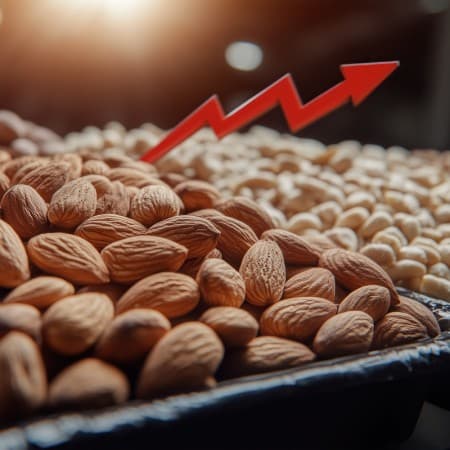
An almond has an unusually long afterlife for something that begins beneath a tree. It can leave a San Joaquin Valley orchard, pass through a huller and sheller, and end up in a container headed overseas, with every stop depending on how much product is still available to move.
That pipeline picked up speed in August. California almond exports reached 143 million pounds, a 31% increase from the same month last year, according to the latest market report. The jump gives handlers a bullish signal, but it also pulls more inventory out of a market already running short of slack.
Reported carry-in supplies are below 500,000 pounds, leaving little old-crop material to cushion buyers or keep shipments comfortable between harvests. For growers, that can make the market feel less like a warehouse and more like a queue: demand arrives, and the available nuts are already spoken for.
A Smaller Crop Meets a Faster Pipeline
The industry is anticipating a crop of around 2.6 billion pounds, with rising production costs and limited alternatives narrowing the room to expand. Almonds are perennial acreage, not an annual switch that can be flipped when a budget gets tight; decisions made years ago keep showing up in today’s receipts.
That combination—strong movement and constrained production—changes the bargaining weather around the crop. A handler with export orders to fill has a reason to keep buying. A grower still calculating irrigation, labor, fertilizer and orchard-removal costs has a reason to ask whether a stronger price can cover the cost of staying in the business.
The almond economy also has side doors. UC Agriculture and Natural Resources researchers describe the crop’s hulls and other residual material as part of a broader agricultural circularity economy, with value extending beyond the kernel. Those outlets do not replace a good kernel market, but they make the orchard’s balance sheet slightly less dependent on a single product.
The Cost of Holding the Orchard Together
For operations facing a narrow margin, market strength arrives alongside an awkward bill. Federal specialty-crop assistance is still available for eligible producers, with payments tied to reported 2025 planted acres and applications based on prior acreage reports, according to Farm Progress. The paperwork may be prefilled; the underlying costs are not.
The immediate question for California almond growers is less whether exports can look strong on paper than how long buyers continue to need that pace of shipments. A tight pipeline can support bids, but it can also expose every weak spot in an orchard plan, from water economics to pruning decisions and the cost of keeping marginal blocks productive.